
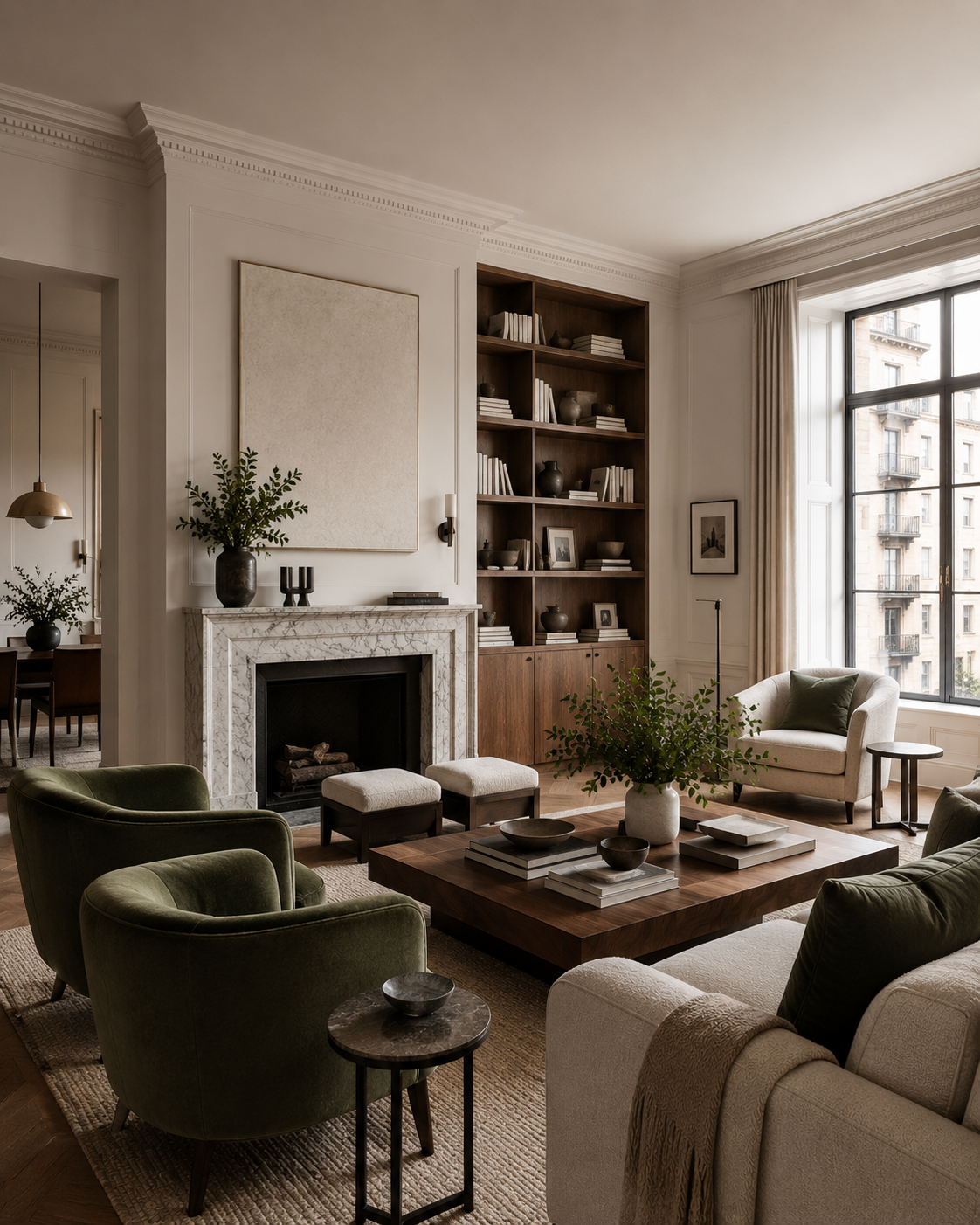
Trends can be useful sources of inspiration, but a home should not feel dated the moment a particular color, material, or silhouette falls out of favor. Timeless interior design begins with a more enduring framework: balanced proportions, honest materials, comfortable furnishings, thoughtful lighting, and a clear relationship between the architecture and the people who live there.
This does not mean creating a neutral or overly restrained interior. A timeless home can be expressive, colorful, richly layered, and deeply personal. Its longevity comes from the intention behind each decision and the coherence of the whole—not from avoiding individuality.
The most refined interiors are not defined by excess. They are shaped by quality, comfort, and a sense of visual order that allows distinctive pieces to hold attention. These principles provide that foundation while leaving room for a home to evolve.
Balance, Scale, and Proportion Create the Framework
Balance determines how visual weight is distributed throughout a room. It may be symmetrical, with related elements arranged on either side of a focal point, or asymmetrical, with different forms and materials carrying comparable visual presence. In either case, the goal is a composition that feels settled rather than rigid or lopsided.
Scale considers how an object relates to the room, while proportion describes how its parts relate to one another. A generously sized sofa may suit a large living room but overwhelm a compact one; a delicate pendant can disappear above a substantial dining table. Ceiling height, window placement, circulation, and architectural details should all inform the size and placement of furniture, rugs, artwork, and lighting.
Successful rooms also include variation. Pairing a low, linear sofa with a taller lamp or balancing a substantial table with visually lighter chairs creates rhythm. The eye moves comfortably through the space because no single element dominates without purpose.
Layer Textures and Patterns with Intention
Texture gives a room depth, particularly when the palette is quiet. Linen, velvet, wool, timber, stone, plaster, woven fibers, and metal each interact with light and touch differently. Layering these surfaces creates richness without requiring an abundance of color or ornament.
Pattern can serve the same purpose when it is edited carefully. Rather than repeating one motif everywhere, vary its scale and intensity: a broad geometric rug might sit beside a smaller botanical textile, while a restrained stripe provides structure. A consistent palette or repeated material can connect the layers so the room feels collected rather than busy.
The strongest combinations often rely on contrast—smooth beside nubby, polished beside aged, tailored beside organic. These relationships make a space visually interesting at a distance and rewarding at close range.
Choose Statement Pieces That Can Endure
A statement piece should anchor a room, not compete with everything around it. It might be a sculptural chandelier, an expressive chair, a significant artwork, a vintage cabinet, or a dining table made with exceptional craftsmanship. Its value comes from form, material, meaning, or provenance rather than novelty alone.
Before selecting a focal piece, consider whether its scale supports the architecture and whether the surrounding elements allow it room to breathe. A memorable object is more powerful when quieter furnishings create a visual pause around it.
Longevity is also emotional. Pieces connected to travel, family history, cultural heritage, or a maker’s hand often remain relevant because their meaning extends beyond a particular trend. They can move between homes and sit comfortably beside new discoveries as a collection evolves.
Build Color Harmony, Not Color Uniformity
A cohesive palette does not require every room to use the same colors. Harmony can come from repeated undertones, related levels of saturation, or a material that travels through the home. A deep green in one room may reappear as a quieter textile accent elsewhere; dark wood, warm metal, or natural stone can provide continuity across different palettes.
Permanent finishes deserve particular care because they are costly and disruptive to replace. Flooring, millwork, stone, and tile should relate to the architecture and work across changing furnishings. Paint, textiles, and accessories can then introduce more flexible layers of color.
White and other neutrals can offer breathing room, but they should support the larger story rather than become a default. Saturated color can be equally enduring when it feels grounded in the home’s light, proportions, and point of view.
Use Layered Lighting to Reveal the Design
Lighting shapes how color, texture, and proportion are perceived. A room that depends on a single overhead source can feel flat even when every furnishing is beautiful. Layered lighting combines ambient illumination, focused task lighting, and accent light for art, shelving, or architectural details.
Fixture scale and placement matter as much as style. A chandelier should relate to both the table beneath it and the volume of the room. Sconces, lamps, and concealed lighting can bring light to different heights, creating atmosphere and making the room more useful throughout the day.
Dimmers and thoughtful controls allow the same interior to support work, conversation, entertaining, and rest. This adaptability is one of the quietest forms of refinement.
Arrange Furniture for Comfort, Conversation, and Flow
Furniture placement should begin with how the room will be used. Seating needs to support conversation without obstructing movement; tables should be within comfortable reach; and circulation paths should feel intuitive. A beautiful layout that makes daily life awkward will not feel timeless for long.
Rugs can define a seating or dining zone, particularly in an open-plan home, while sight lines help connect adjoining spaces and views. Negative space is equally important. Leaving deliberate areas open gives the room rhythm and allows architecture, art, and individual furnishings to register.
The final measure is ease. When a room welcomes people naturally, accommodates their routines, and can adapt as those routines change, function becomes part of its beauty.
Let Quality and Personal Meaning Outlast Trends
Timeless design favors fewer, better choices: materials that age gracefully, furniture that can be repaired or reupholstered, and craftsmanship that remains apparent over time. Quality is not simply a matter of cost. It is visible in how an object is made, how well it performs, and whether it continues to contribute to the home years later.
Personalization is just as important. Art, books, heirlooms, handcrafted objects, and culturally meaningful pieces prevent an interior from feeling like a showroom. At Ikorodu Interiors, we often layer Nigerian and West African art, rich woods, sculptural forms, and globally sourced objects into a design in conversation with the client’s own history and the architecture.
A timeless home is therefore never static. It has a strong enough foundation to welcome new art, rearranged furniture, evolving collections, and the changing needs of the people within it. Refinement is not perfection or excess; it is the clarity to choose what belongs and the confidence to let a home become more personal with time.